Ancient Roots: The Game Before the Board
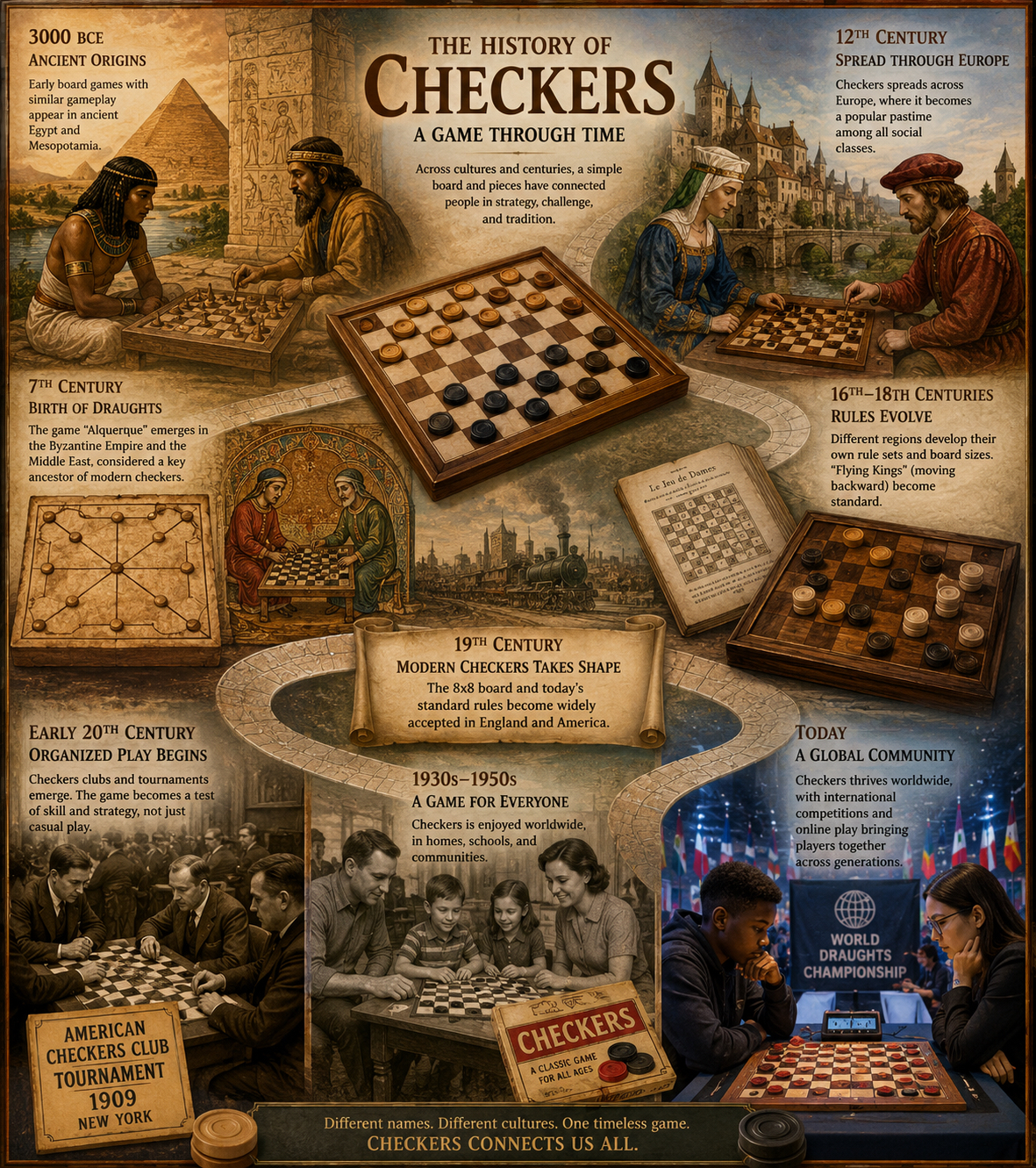
Long before the familiar black-and-red board existed, the ancestors of Checkers were being played across the ancient world. Archaeologists excavating the ancient city of Ur in modern-day Iraq unearthed game boards and playing pieces dating back to around 3000 BCE. In ancient Egypt, a game called Alquerque — played on a 5×5 grid with diagonal moves and captures — is considered the most direct ancestor of modern Checkers. Evidence of Alquerque has been found etched into the roofing slabs of the temple at Kurna, placing it in the same era as some of the oldest known board games.
Alquerque spread westward through trade and conquest, carried by merchants along Mediterranean sea routes and by soldiers across desert campaigns. The Romans played a version called "Ludus Latrunculorum," a game of soldiers and captures that shared the same spirit of diagonal confrontation. What united all these early variants was a deceptively simple idea: two opposing forces, one board, and the rule that a stronger piece can jump over a weaker one. That single mechanic would echo through millennia.
Medieval Reinvention: Alquerque Meets the Chessboard
The pivotal transformation of Checkers happened in medieval France around the 12th century. An unknown but inspired player had the idea of transplanting Alquerque's rules onto the much larger 64-square chessboard. This single change — expanding the playing field — dramatically increased the strategic depth of the game. More pieces, more space, and more possibilities turned a modest pastime into a genuine test of tactical thinking. The French called their creation "Fierges," and it quickly spread across Europe under many names.
In England, the game became known as "Draughts," a name derived from the Old English word for the act of moving a piece. Across the English Channel, it was "Jeu de Dames" — the Game of Ladies — a name that survives in many European languages today. By the 16th century, a crucial rule was codified that would define competitive play forever: mandatory capture. If a jump was available, a player was obliged to take it. This single rule transformed Checkers from a casual leisure game into a discipline that demanded foresight, sacrifice, and strategic planning several moves in advance.
The Art of the Jump: Strategy and the King
At the heart of Checkers lies an elegant tension between offense and defense. Regular pieces move only forward, limiting their reach and making positioning everything. The game rewards patience — a player who controls the center and maintains a solid back rank forces their opponent into increasingly difficult choices. Every advance carries risk, because a piece that moves forward becomes a potential target for a chain of captures that can strip a player of multiple pieces in a single devastating sequence.
The transformation of a piece into a King — achieved by reaching the opponent's back row — changes the game's entire character. Kings move both forward and backward, becoming powerful hunters capable of dominating the board. Yet obtaining a King requires crossing the entire board, a journey fraught with danger. The best players balance the urge to crown pieces with the need to maintain structural integrity. The "running exchange," where a player sacrifices pieces to gain a positional or numerical advantage, remains one of the most thrilling tactics in the game. Checkers, at its highest level, is chess condensed: every move carries consequence.
A World Game: Draughts Across Cultures
As Checkers spread across the globe, different cultures shaped it to their own tastes and traditions. The most significant variation is International Draughts, played on a 10×10 board with 20 pieces per side and long-range Kings that can traverse the entire board in one move. This version dominates competitive play in the Netherlands, Russia, and much of Africa. In Brazil, the game is played on a 64-square board but with flying Kings, blending English and international rules into a uniquely South American hybrid.
Turkish Draughts moves pieces orthogonally rather than diagonally, creating an entirely different flow of play. In Canada, the 12×12 board pushes the complexity even further. Perhaps the most culturally significant variant is Damka in Russia and Eastern Europe, where the game carries deep social meaning and has been played in parks, clubs, and cafes for generations. Despite all their differences, these variants share the same ancient heartbeat: advance, threaten, capture, and crown. The diversity of Checkers traditions across six continents is testament to a game that belongs to all of humanity.
The Solved Game: Checkers in the Digital Age
In 2007, computer scientist Jonathan Schaeffer of the University of Alberta announced one of the most significant milestones in game theory: Checkers had been solved. After nearly two decades of computation, his program Chinook had analyzed every possible position from every possible endgame state, proving definitively that perfect play from both sides leads to a draw. The announcement sent shockwaves through the gaming world. For the first time, a game played by millions of people across thousands of years had been reduced to mathematical certainty.
Yet Checkers did not die with its solution — it thrived. The vast majority of human players will never come close to perfect play, meaning the game retains its full challenge for all but the most elite competitors. Online platforms and mobile apps have introduced Checkers to entirely new generations who might never have encountered a physical board. Schools use it to teach logical thinking and cause-and-effect reasoning. And in competitive circles, human champions continue to battle at the highest levels, knowing that somewhere beneath their play lies a perfect game that no human has ever managed to play. Checkers remains, as it has always been, a mirror held up to the human mind.