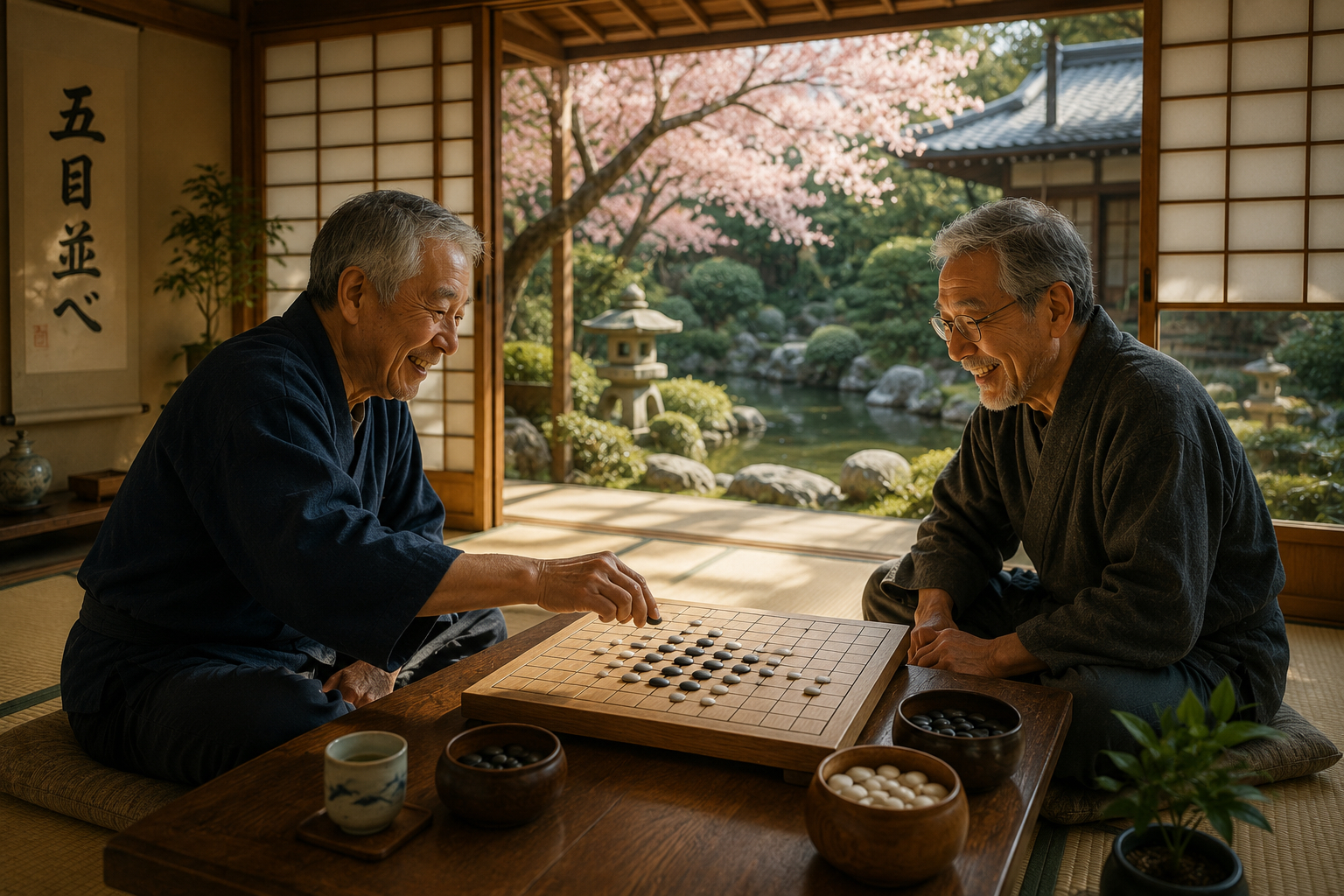
Origins in East Asia: A Line of Five
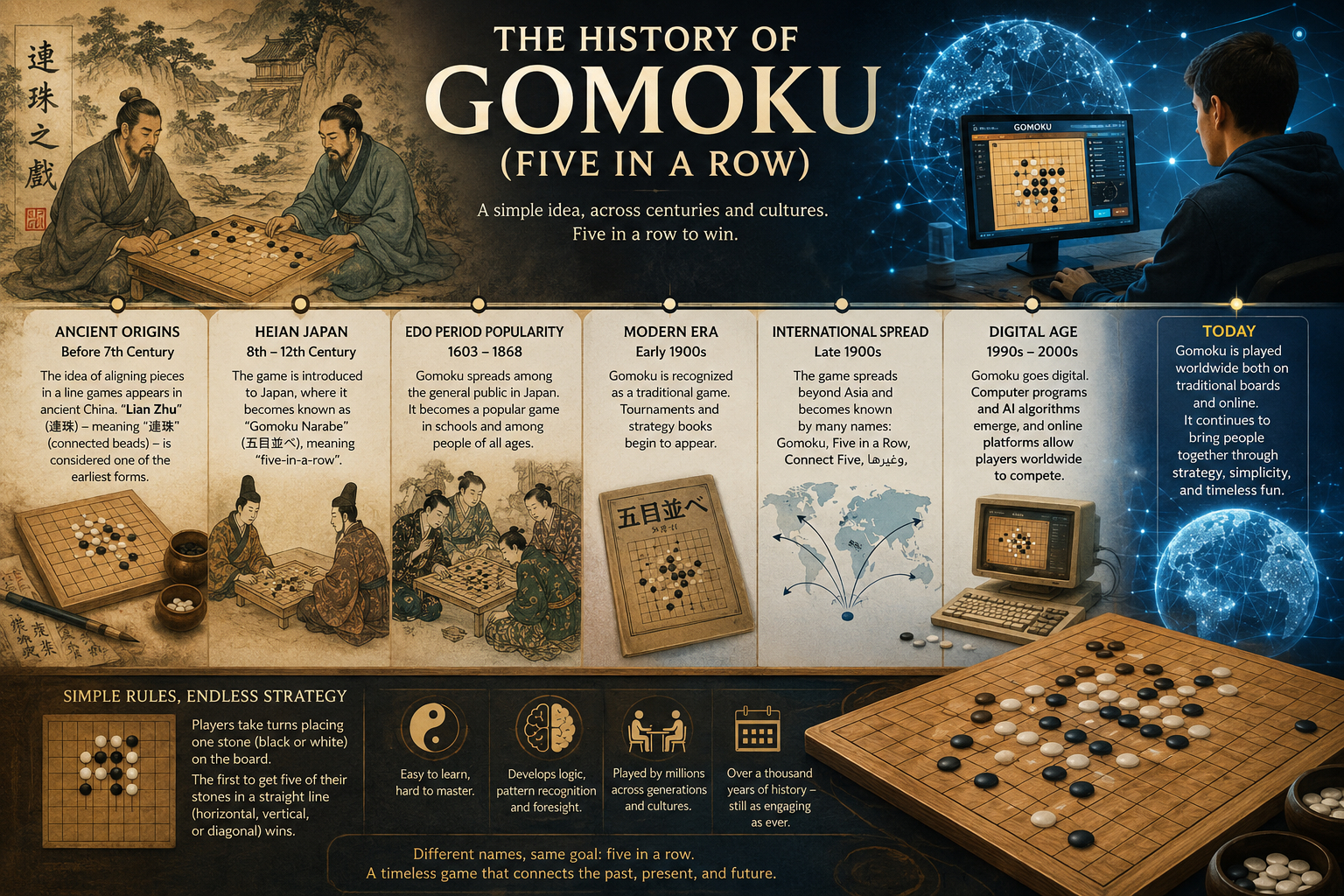
Gomoku, literally "five stones" in Japanese, is widely believed to have deep roots in ancient East Asia. The core idea is elegantly direct: place stones on a grid and complete an unbroken line of five before your opponent does. Historians often link early forms of the game to Chinese line-making board traditions that later traveled into Korea and Japan. By the Edo period in Japan, the game had become a recognized pastime among both commoners and educated circles.
The game's popularity came from its low barrier to entry. You did not need expensive pieces or a special board to begin playing. Any gridded surface could host a match. Yet this simple setup concealed a surprisingly complex strategic world of threats, counter-threats, and long-term planning. That contrast between accessibility and depth is one reason Gomoku endured for centuries.
Standardization and Spread Beyond Japan
As Gomoku gained structure in the 19th and early 20th centuries, published rule sets began to circulate more widely. The game was frequently played on a 15x15 grid, and opening patterns became a serious topic among strong players. In this period, one strategic imbalance became obvious: the first player usually had a major advantage when both players were skilled. This sparked a long history of rule innovations designed to keep games fair.
Gomoku expanded internationally through cultural exchange, magazines, and eventually board-game clubs in Europe and North America. Its easy-to-learn nature made it ideal for classrooms and casual settings, while serious players continued to build an increasingly sophisticated theory of attack and defense. By the late 20th century, Gomoku existed as both a friendly pencil-and-paper game and a competitive mind sport with growing formal attention.
The Fairness Challenge: From Free-Style to Renju
One of the most important chapters in Gomoku history is the effort to reduce first-move dominance. Free-style Gomoku allows five or more in a row for victory and generally has minimal restrictions. Competitive communities, however, developed balancing rules such as swap openings and restricted patterns for the first player. These rules reshaped high-level play and made tournaments far more dynamic.
A major related discipline is Renju, a professionalized variant that introduces specific forbidden moves for Black, including certain overpowered formations. Renju helped establish a more symmetrical competitive framework and developed its own international federation and championship culture. While Renju and Gomoku are not identical, their histories are intertwined through the shared goal of preserving strategic fairness without sacrificing the spirit of line-building combat.
Computers, Solvers, and the Online Era
Like many abstract strategy games, Gomoku became an important target for computer research. Programs steadily improved at tactical reading and pattern evaluation, challenging human experts and accelerating theoretical development. Engine analysis exposed weak openings, validated defensive resources, and sharpened preparation for serious players. The relationship between human intuition and machine calculation became central to modern training.
The internet transformed Gomoku from a local hobby into a global ladder sport. Online servers made it possible to play instantly across continents and track rankings in real time. Mobile apps introduced millions of newcomers, many of whom moved from casual play into competitive formats. Today, Gomoku thrives in both forms: a quick social game and a demanding strategic discipline supported by deep opening books and computer-assisted study.
Why Gomoku Still Matters
Gomoku remains one of the clearest demonstrations of how simple rules can generate complex thought. In a few moves, players learn about initiative, tempo, pattern recognition, and risk management. It is easy enough for children to begin in minutes, yet rich enough that experts spend years refining positional judgment. That educational and competitive duality keeps the game relevant across generations.
From its East Asian origins to modern digital competitions, Gomoku has shown remarkable adaptability. It survived by evolving: first through local traditions, then through standardization, and now through global online ecosystems. The board may look quiet, but every stone carries history. In Gomoku, each line of five connects not only points on a grid, but centuries of strategic culture.