From Halma to a New Idea
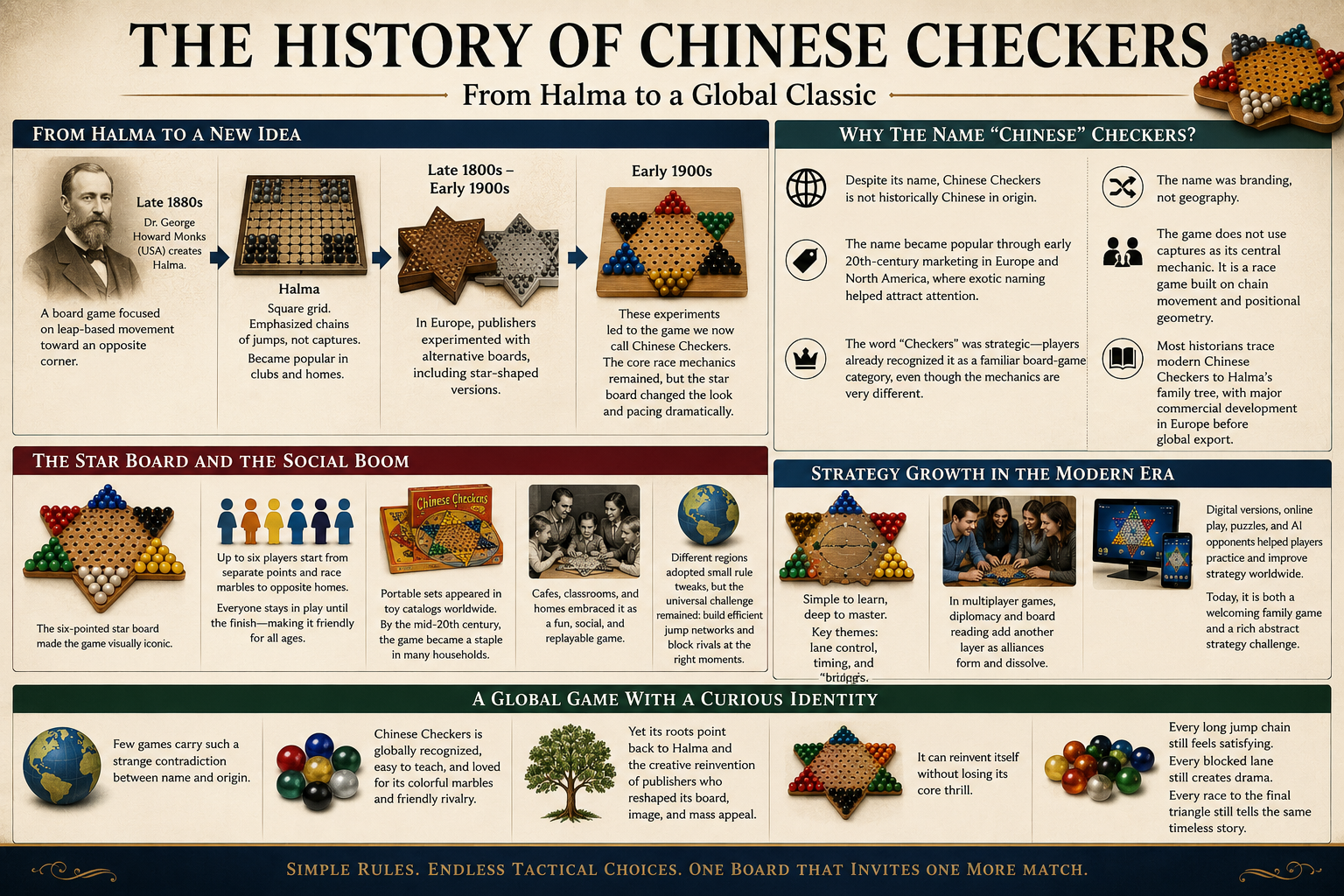
The story starts with Halma, a board game created in the late 1880s by Dr. George Howard Monks in the United States. Halma used a square grid and focused on leap-based movement toward an opposite corner. Its design rewarded planning chains of jumps rather than direct captures, and it quickly became popular in clubs and homes. In Europe, publishers experimented with alternative boards, including star-shaped versions that made movement feel more open and dramatic.
Those experiments were the bridge to what we now call Chinese Checkers. The core race mechanics remained, but the star board changed both the visual identity and the pacing of play. Suddenly, the game looked distinct from other race games and became easier to market as something fresh.
Why the Name "Chinese" Checkers?
Despite its name, Chinese Checkers is not historically Chinese in origin. The title became popular through early 20th-century marketing, especially in Europe and North America, where exotic naming was often used to attract attention. The word "Checkers" was also strategic, players already recognized checkers as a familiar board-game category, even though the mechanics are very different.
In other words, the name was branding, not geography. The game does not use captures as its central mechanic, and it is fundamentally a race game built on chain movement and positional geometry. That mismatch between name and origin has become one of the most interesting parts of its history.
As a history note, most historians trace modern Chinese Checkers to Halma's family tree, with major commercial development occurring in Europe before global export.
The Star Board and the Social Boom
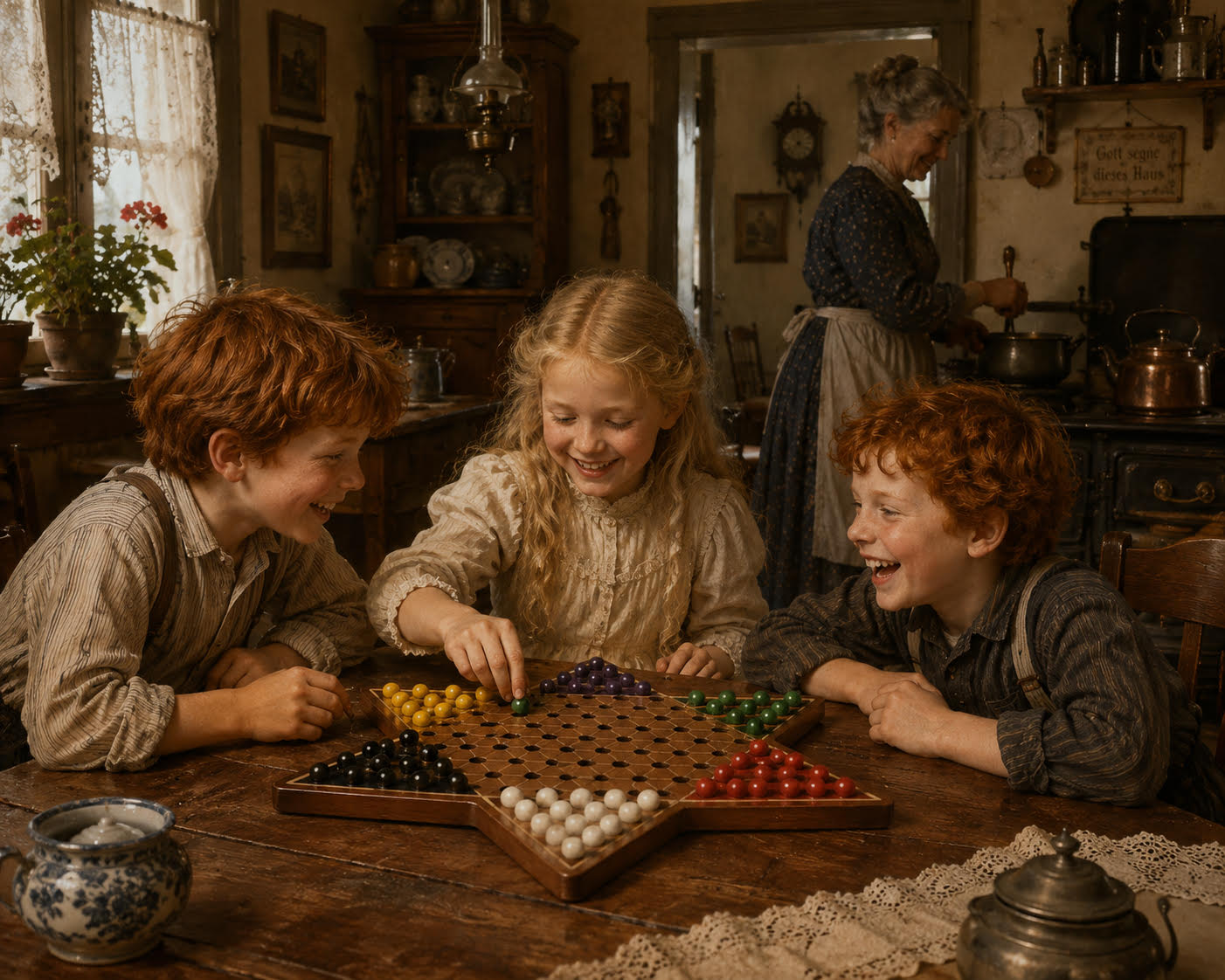
The six-pointed star board made the game visually iconic. Up to six players could start from separate points and race marbles to opposite homes, creating a social format that worked for families, classrooms, and cafes. Unlike elimination games, everyone stayed in play until the finish, making sessions friendlier and often more replayable for mixed-age groups.
Its portability helped too. Compact wooden or plastic sets appeared in toy catalogs worldwide, and by the mid-20th century the game had become a staple in many households. Different regions adopted small rule tweaks, but the central challenge remained universal: build efficient jump networks while blocking rivals at exactly the right moments.
Strategy Growth in the Modern Era
At first glance, Chinese Checkers can feel simple: move one step or jump repeatedly. Yet strong play quickly reveals deep positional themes. Players evaluate lane control, timing, and "bridge" construction, where your own marbles become launch points for long chains. In multiplayer games, diplomacy and board reading add another layer as temporary alliances form and dissolve.
Digital versions accelerated this strategic culture. Online play, puzzle modes, and AI opponents helped players practice openings and midgame route optimization. Today, Chinese Checkers lives in two worlds at once: a welcoming family race game and a surprisingly rich abstract strategy challenge.
A Global Game With a Curious Identity
Few games carry a stranger contradiction between name and origin. Chinese Checkers is globally recognized, easy to teach, and strongly associated with colorful marbles and friendly rivalry. Yet its roots point back to Halma and to the creative reinvention of publishers who reshaped its board, image, and mass appeal.
That journey is exactly why the game endures. It can reinvent itself without losing its core thrill. Every long jump chain still feels satisfying, every blocked lane still creates drama, and every race to the final triangle still tells the same timeless story: simple rules, endless tactical choices, and a board that invites one more match.